
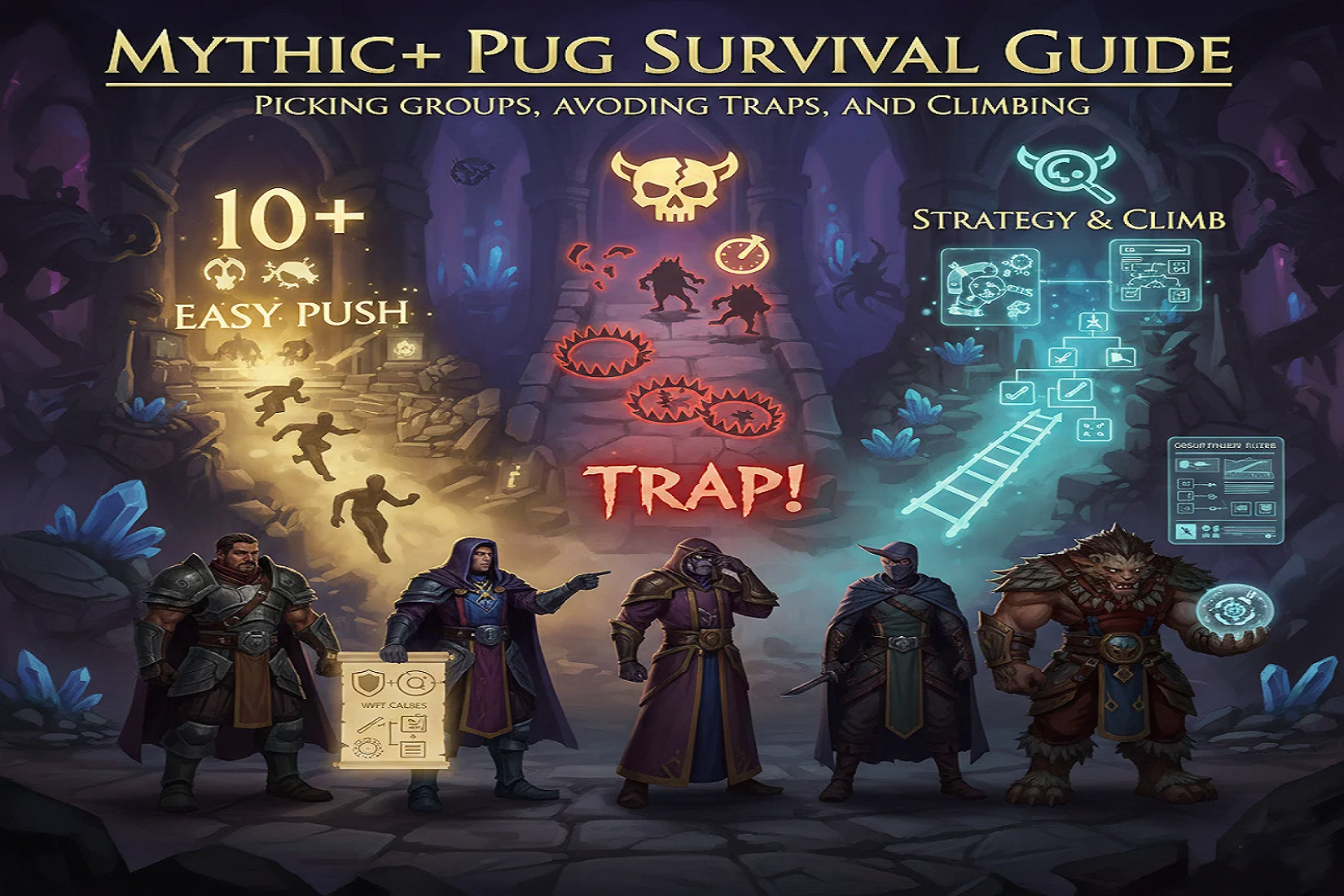
Mythic+ PUG Survival Guide – Picking Groups, Avoiding Traps, And Climbing
Mythic+ PUGs are not very often lost due to a single player “not having the DPS”. The reason behind their failure is that the expectations of the group are not aligned to the reality of the key: no stops plan, no consensus on pace and not a shared concept of what really kills the run. The climbing players are always less fortunate and more discriminating.
The three habits that form a powerful strategy are: selecting the right groups, making wipe causes simple to communicate and making each run a repeatable process and not a gamble.
Read the listing like it’s a contract
A Mythic+ listing is an abbreviated term of the priorities of the leader. The best leaders tend to be honest in very few words.
What can be more important than item level:
One useful filter is to choose groups that specify how the key will be played (safe route, controlled pulls, planned Bloodlust timing) over groups which specify how good they would like players to be
The three PUG traps that waste the most keys
The majority of unsuccessful runs are predictable.
Trap 1: Pace mismatches
The ability of a tank to chain-pull like that can be very good, but in a random group it tends to put healers behind on mana and DPS behind on interrupts due to movement disorder.
Trap 2: No plan for stops and priority casts
In numerous dungeons, there will be packs in which a single cast is more important than others. When the group considers “interrupts as freestyle” by everyone, the coin is tossed.
Trap 3: Silent defensives
The fact that PUG deaths commonly occur due to players pressing defensives late and not the lack of such is a common occurrence. In cases where no one makes a defensive, healers are pushed to panic triage and the run falls on the first overlap.
A quick “first pull” audit that predicts the whole run
The first pull is a diagnostic. Players that intend to climb should assess a group at once.
Signs, which can be counted upon in the first minute:
The red flags that are not to be overlooked:
Role expectations that prevent scapegoating
PUGs blame the most obvious failure. Players seeking to have stable runs are the least anarchic member of the group.
Tanks: predictable tempo beats heroic tempo
In PUG keys, a tank has the actual task of rendering the pulls readable. Risky chain pulls generally are not as effective as clean line-of-sight, consistent positioning, and controlled pack size. A stabilizing tank is likely to be re-invited.
DPS: priority and survival win more keys than meters
High-danger casts kicked by DPS players, priority target swapping, and surviving overlaps frequently “carry” runs compared to the best parser who dies twice. Survival is the most important contribution in DPS in most PUGs.
The point where time becomes the real bottleneck
Once a player has mastered the fundamentals, they tend to stagnate due to a non-skill factor namely group volatility. Runs are killed by leavers, intermittent routes and unmatched expectations instead of mechanics.
It is one of the few cases when a structured alternative such as a WoW Mythic boost is described in a pragmatic manner by time-constrained players: not as an alternative to learning, but as a means of saving time that would otherwise be spent in unstable PUGs and achieving the weekly objectives.
Communication that works in PUGs without turning into a lecture
PUG communication is ineffective when it is not present or it is over-complicated. Short and role-based style is the most effective.
Cases of “small callouts” which vary the results:
A team does not require an entire strategy meeting. It requires two or three behaviors that are agreed upon that will avoid recurrence of deaths.
When structured runs become a predictable alternative?
The players who consider Mythic+ to be their primary endgame cycle do not necessarily have a fixed team to push with. Once volatility is the actual obstacle, a structured run like a WoW Mythic boost can be considered a time-management tool, and not a shortcut.
Community terminology may frequently describe the concept as a WoW M+ boost, which is a guided key with more apparent pacing and fewer random variables than a typical PUG. The shorter label M+ boost may be also found in the same context.
Other players have more general terms such as WoW Mythic plus boost when comparing the timing, communication and what the run entails. Mythic plus boost can be expressed in the same manner depending on the manner in which the discussion is framed.
In cases where the aim is narrower, it is often referred to as WoW Mythic+ boost, which often reflects a specific target, like a specific key level, a weekly completion, or a score threshold. In informal slang, it is commonly said as Mythic+ boost.
The “carry” wording is more inclined towards leadership and route control. You will find WoW Mythic carry used when it is expected that the group will deal with route calls and pacing, and a more relaxed term such as Mythic boost can be used to refer to a variety of structured formats.
A simple climbing plan that avoids burnout
Efficiently climbing players do not “spam keys forever”. They separate farming from pushing.
A repeatable weekly pattern:
An alternative attitude change that can be put into practice is to consider a depleted key as information. When the same failure recurs (as in the case of deaths on a predictable pack), it is not that “better players” will help. A superior plan at that moment is a solution.
The exit rule that saves the most time
Knowing when to leave is the most underestimated PUG skill.
It is logical to leave early when:
“Resilience is hardly taught” by remaining in a failing environment. It typically burns the very resource Mythic+ requires the most time.
Closing perspective
The success of Mythic+ PUGs is not so much about optimal play but rather about foreseeable play. Players climb when they do it purposefully, only say what is important, and use keys in a repeatable process rather than wishing to have a perfect lobby. In cases where the volatility is the key obstacle, structured options can be found in the discussion, yet the long-term gain remains based on the same principles: interrupts, defensives, pace control, and a smarter choice of a group.